

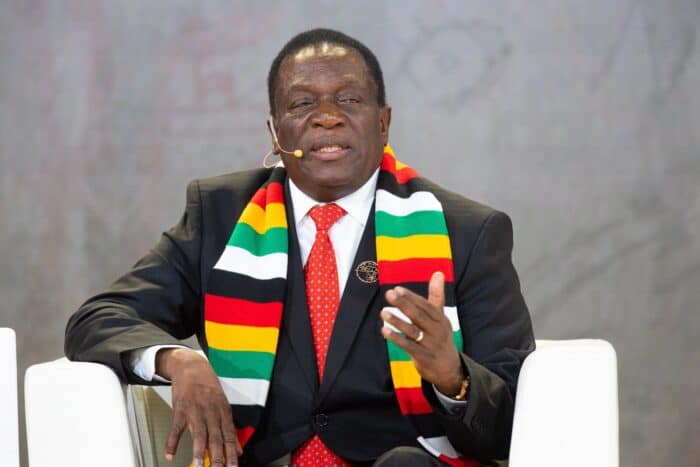
Chris Musekiwa
The Councillors Indaba with the President is a forum which was created to bring all councilors together and meet the State President, debate, and share ideas. This was said by His Excellency the President Dr. Emmerson Mnangagwa when he met with about 1958 councilors from all local authorities recently at the Harare International Conference Centre. The Indaba was held under the theme “Strengthening Local Governance through Devolution for the Attainment of Vision 2030”.
“We created this forum because we felt that every single councilor, wherever they are is as important as those who are near the seat of power and this (Vision 2030) can only be achieved if we have platforms where all of us can debate and share ideas,” said the President. He added that the Indaba platform equalized all the councilors, urban and rural, because they were all councilors with no super councilors among them.
The Councillors Indaba with the President was jointly organized by the Ministry of Local Government and Public Works and the Zimbabwe Local Government Association (ZILGA) which is an umbrella organization of the country’s two local government associations, the Association of Rural District Councils of Zimbabwe (ARDCZ) and UCAZ. This was the first time that all the councilors from the country’s 92 local authorities (60 rural districts and 32 urban councils) met with the President. However, President has been the Guest of Honour at the two associations’ conferences before.
In his keynote address, the President talked about the devolution and decentralization agenda which is being championed by his administration. He said that the devolution and decentralization agenda was entrenching participatory democracy by ensuring that resources, powers and functions are given to communities at the grassroots level.
He said that local authorities were indispensable partners who must provide timely programs and projects to guarantee equitable development that leaves no one and no place behind.
President Mnangagwa urged local authorities to scale up the implementation of the devolution agenda. He added that local authorities were set to have added responsibilities to facilitate a seamless transition to the broadened scope of their mandates, functions and duties. Government, he said, adopted a comprehensive devolution and decentralization policy that guides the process while removing gaps and ambiguities in the process. Under the new policy, he added, local authorities would be further capacitated to efficiently and effectively manage affairs within their jurisdictions.
He further said that under the whole-of-government and society approach, ministries, departments and agencies of government were being directed to provide local authorities with requisite support.
Additionally, he said, local authorities should prioritize the creation of a conducive and enabling business operating environment right at the community level. At the central government level, we are accelerating the alignment of the outstanding Acts of Parliament to our national constitution. Under the ease of doing business reforms, the adoption of global best practices is set to consolidate our economic growth trajectory and enhance our country’s attractiveness as a favorable investment destination. The ongoing reforms are also cognizant of the demands to strengthen the local government sector and empower citizens to fully participate in both national and local government development initiatives. In fact, a progressive country is recognized by the efficiency of the local authorities.
“As a result of our Second Republic policy on devolution, I see that even the remotest of rural councils are now exercising that right to decide what they need at that level through devolution funds. I, therefore. urge you as stakeholders in this tier of government to scale up your commitment to improving the quality of lives of the citizenry through the provision of quality services,” said the President.
The President further said that the broad mandates local authorities have been given in the national constitution, enabling legislation and other policies should translate into a higher quality of life for residents.
“The ongoing efforts under the Second Republic to accelerate the realization of vision 2030 demands that the current crop of public officials must be patriotic, astute, and prudent and stewards over all facets of public administration and this burden is upon all of you,” he said.
He challenged both councilors and council officials to adhere to the principles of good public administration as espoused in chapter 9 of the national constitution.
The President said that in keeping with the culture of his administration, public officials are servants of the people of Zimbabwe and that they must exhibit a greater sense of commitment to wholeheartedly serve citizens at the local level.