


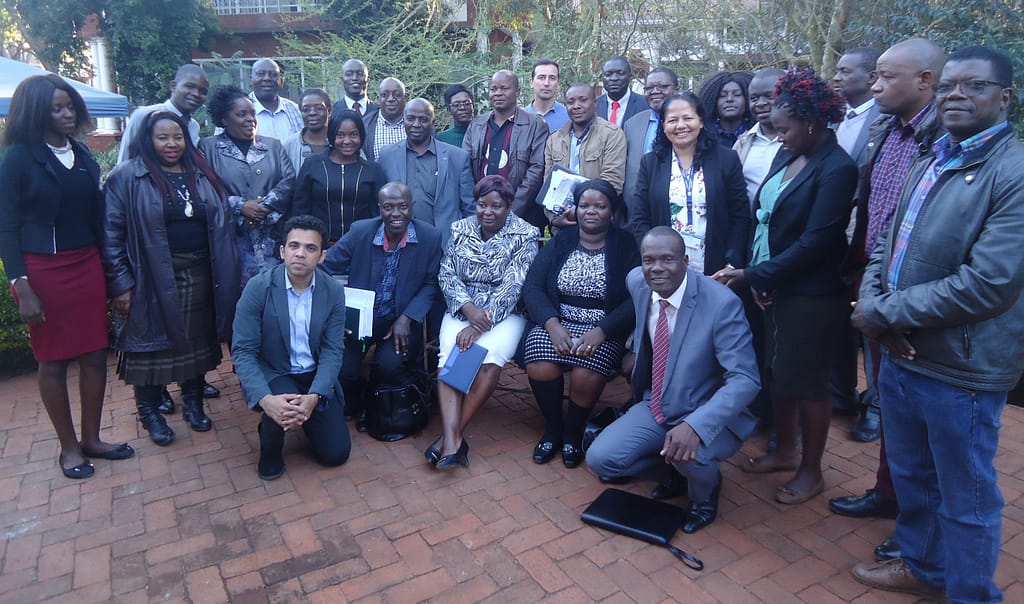
Participants at the Urban Resilience workshop held at the UNDP offices, Mount Pleasant, Harare
Growing urban populations, rural to urban migration, climate change, natural disasters, food insecurity, social and political instability, and declining economy are some of the factors that cities are increasingly having to deal with. These are shocks that cities have to absorb through what has been termed urban resilience. A common definition of urban resilience is the “measurable ability of any urban system, with its inhabitants, to maintain continuity through all shocks and stresses, while positively adapting and transforming towards sustainability”.
Therefore, a resilient city is one that assesses, plans and acts to prepare for and respond to hazards – natural and human-made, sudden and slow-onset, expected and unexpected. Resilient cities are better positioned to protect and enhance people’s lives, secure development gains, foster an investible environment, and drive positive change. In Zimbabwe, urban resilience is a topic that has just begun to be discussed thanks to an initiative by UNDP. In 2018 UNDP and UNCEF initiated a programme entitled “Partnerships for building urban resilience in Zimbabwe”. The aim of the programme is to support cities in addressing key vulnerabilities and to build resilience over the long term. The objective is to develop an urban resilience model in selected towns as well as generating evidence and knowledge to strengthen urban resilience in the country.
The programme includes pilot projects in cities, capacity building activities, research and strategic planning. The expected results of the programme are; improvements in urban environment, access to basic public services, WASH, employment, livelihoods, opportunities for youth and women in unserved and underserved urban areas and a developed evidence based framework or strategies for building urban resilience. UCAZ leadership represented by the Presidential Committee and the executives of the officers’ forums were recently introduced to urban resilience. The purpose was to inform the Urban Resilience Systems Analysis of Zimbabwe by consulting key local stakeholders concerning urban systems, shocks and stressors, current strengths and challenges in managing cities as well as opportunities and priorities to address the challenges and build urban resilience which will be considered when developing the urban resilience systems at a later stage. Within this project UNDP and UNICEF have initiated specific activities to gather comprehensive evidence to support urban planning in Zimbabwe with a focus on building resilience. Arup and Plan International have been contracted to conduct research and support the development of an overall strategy for programming urban resilience in cities.
Their work started in June 2019 and should be completed in October 2019. The objective of the assignment is to gather evidence to bridge the knowledge gap on the understanding of urban resilience baseline in cities and to develop recommendations to influence UNDP and UNICEF’s planning and investment decisions. In his presentation entitled “Partnerships for Building Urban Resilience in Zimbabwe” UNDP Programme Analyst, Governance, Mr Wadzanai Madombwe said urban resilience was a building area that had not been explored. He analysed the situation in Zimbabwe as characterised by; increasing and recurring cases of Cholera and Typhoid, predominantly young urban population making up 84% of the unemployed, educated, and under-utilised youth paving way for social tensions. Low infrastructure investment in water and sanitation, waste management, electricity, health services, transport, highly informalised economy characterised by low productivity leading to loss of revenue for and poor service delivery by local authorities. Urban resilience to what?
The presentation looked at the immediate challenges that urban councils needed to build resilience on. These include; water and sanitation, unemployment and underemployment and weak institutional governance. Chairperson of the Town Clerks’ Forum, Dr George Makunde made a presentation on behalf of UCAZ in which he highlighted the readiness of urban local authorities in embracing urban resilience as evidenced by the Service Level Benchmarking (SLB) Programme and Peer Review mechanism being implemented by UCAZ. SLB seeks to improve service delivery by measuring and comparing performance among urban councils using agreed international service delivery benchmarks. Participants urged local authorities to take an inclusive approach to planning. Participants agreed that the private sector, nongovernmental organisations and academia were key stakeholders in the Urban Resilience Programme. UCAZ will give updates on any developments regarding Urban Resilience.