
Solid waste management (SWM) remains an issue in Zimbabwe’s urban areas. Waste generation rates are outweighing the capacity of local authorities to manage waste from areas under their jurisdiction. As a result, the majority of local authorities are failing to cope with the waste.
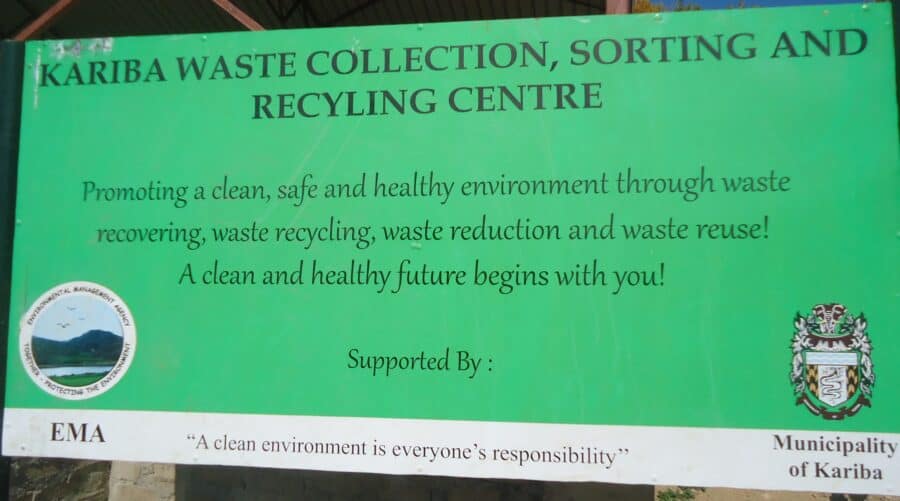
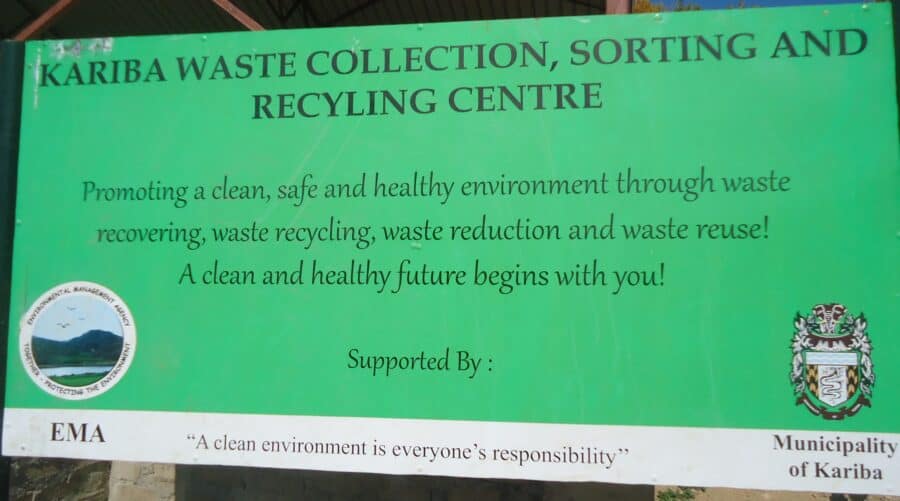
Signpost at the Waste Collection, Sorting and Recycling Centre
In addition, solid waste disposal sites do not meet the environmental standards for effective waste disposal, leading to environmental pollution. Given the dire financial situation the local authorities are facing, they are not able to acquire sufficient refuse disposal equipment.
Adding to the financial challenges, the refuse collection and disposal methods being used by the local authorities are expensive and unsustainable in the long run. Most countries have embraced the integrated solid waste management model as a more effective and efficient way to handle solid waste. However, adoption of this new model has been slow in developing countries including Zimbabwe. With the support of GIZ, Kariba Municipality embraced and adopted an integrated solid waste management model. The Municipality has developed an Integrated Solid Waste Management Plan (ISWMP) based on the integrated solid waste management strategy framework.
Kariba is a wild life area. There have been reported cases of elephant deaths due to suspected ingestion of poisonous material at the dumpsite which was not fenced off. This led Kariba to improve its waste management practices.
Kariba’s road to an integrated solid waste management model (ISWMM) started with an introductory course in integrated solid waste management targeting five local authorities, namely Norton, Bulawayo, Chinhoyi, Gweru, Kadoma and Kariba. After the training, Kariba Municipality also participated in a GIZ-organised workshop on designing and implementing integrated solid waste management in local authorities. This workshop resulted in the Kariba Municipality to adopt the integrated solid waste management as a policy.
The adoption led to the development of Kariba’s ISWMP and its implementation with the support GIZ. The Integrated Solid Waste Management (ISWM) Programme is based on the integrated waste management and uses the following waste treatment options;
- Waste prevention mainly through education and awareness raising.
- Waste recycling focusing on the recovery of aluminum cans, plastic (PET) and scrape metal
- Composting of biodegradable material
- Landfilling-improving on the disposal of waste at the landfill
Results of ISWM Initiatives
Major outcomes from ISWM initiatives include the following;
- The Municipality now has a recycling shade which is used to recover some material such as cans and plastic from its waste stream.
- The Municipality now has can crusher and a bailing machine, two important equipment for can recovery and plastic recovery from its waste streams.
- Awareness on better solid waste management has increased in Kariba
- Kariba now has a documented strategic plan to guide progress towards a fully-fledged ISWM.The same can also be used for purposes of fund raising for SWM projects and initiatives.
- The multi-stakeholder approach has increased community participation in solid waste management, thus contributing to participatory urban management and its benefits.
- The project has enabled linkages between Kariba Municipality and other key stakeholders such as Delta and Petrecozim, an important factor in successful ISWM operations.
Stakeholders received training in the operation of the recycling equipment by Delta as well as in recycling material identification by Petrecozim.
Program status
The Kariba ISWM program is in its early implementation phase. The program has experienced some drawbacks including the theft of the power cable for the can crusher. However, the stakeholders are in the process of addressing the drawbacks. During a recent review meeting, stakeholders agreed to make changes in the program design to improve implementation success and sustainability.ISWM remains the viable solution to the refuse collection and disposal model that is currently in use in Zimbabwe.
If done well, ISWM reduces the overall operational costs while increasing collection rates as well as contributing to other global challenges of sustainability and climate change. Although transitioning from refuse collection and disposal to ISWM operations is a process, having a documented strategy and plan is a good starting point. As shown in the case of Kariba, the process of developing the plan itself brings together the community and provides common ground for addressing SWM challenges. It also unlocks opportunities for support and securing material and financial resources to improve SWM operations.